
Air Compressor Selection Guide: How to Choose Between Piston, Screw, and Mobile Air Compressors?
When purchasing an industrial air compressor, the biggest risk is not necessarily paying too much. It is choosing the wrong machine for the application.
An undersized compressor may fail to meet production demands. An oversized unit may increase the initial investment and operating costs. Choosing a fixed-speed compressor when air demand fluctuates significantly may lead to unnecessary energy consumption. And purchasing an electric mobile compressor for a remote construction site without a reliable power supply can make the equipment unusable.
Selecting an air compressor is not simply about comparing brands, motor power, and prices. The right choice depends on actual air demand, operating conditions, working environment, and compressed air quality requirements.
This guide explains the main types of air compressors, their applications, important technical parameters, and common purchasing mistakes. It is designed for industrial buyers, contractors, distributors, and anyone who wants to understand the basics of air compressor selection.
1. Understand Your Air Requirements Before Choosing a Compressor
The first step in selecting an air compressor is to understand how the compressed air will be used.
Before comparing equipment, consider the following questions:
How many hours per day will the compressor operate?
Will it run continuously or intermittently?
What working pressure is required?
How much compressed air is needed?
What equipment or production process will use the compressed air?
Is a stable electrical power supply available at the installation site?
Operating hours and air consumption are particularly important factors.
1.1 Intermittent Air Demand
Typical applications include:
Automotive repair shops
Tire service centers
Small machine workshops
Small-scale painting operations
Individual repair workshops
In these applications, compressed air is not required continuously. The compressor operates when needed and may stop or unload when air demand decreases.
For applications with relatively low air consumption and short operating periods, a piston air compressor may be an economical option.
Its main advantages often include a relatively simple structure, lower initial investment, and straightforward maintenance.
1.2 Long Operating Hours or Continuous Air Demand
Typical applications include:
Automotive manufacturing plants
Textile factories
Food processing facilities
Chemical plants
Large machinery workshops
These industries often require a stable supply of compressed air over extended operating periods.
Rotary screw air compressors are widely used in industrial applications because they are suitable for extended operation and can provide a relatively stable air supply.
However, not every screw compressor is designed for unlimited continuous operation under all conditions. Actual operating capability depends on the manufacturer's specifications, equipment design, ambient conditions, and maintenance requirements.
Similarly, not all piston compressors are unsuitable for continuous operation. Different models have different duty-cycle ratings, which should always be checked in the manufacturer's technical documentation.
1.3 Outdoor Construction and Mobile Applications
Typical applications include:
Mining operations
Tunnel construction
Road construction
Bridge projects
Outdoor drilling operations
These applications often require mobile air compressors.
If there is no reliable external power supply, a diesel-powered mobile air compressor may be a suitable choice.
If electrical power is available but the equipment needs to be moved between work locations, an electric mobile air compressor may be more appropriate.
Key questions to ask before purchasing:
Is electrical power available at the site? What air pressure and flow rate are required? How frequently will the compressor need to be relocated?


2. Piston Air Compressors: Suitable for Small and Intermittent Applications
A piston air compressor, also known as a reciprocating air compressor, uses a piston moving back and forth inside a cylinder to compress air.
In simple terms, the piston draws air into the cylinder and compresses it through reciprocating movement, increasing the air pressure.
2.1 Main Features of Piston Compressors
Relatively simple construction
Generally lower initial purchase cost
Suitable for small-scale applications
Straightforward maintenance and repair
Some models can provide relatively high working pressures
Often produce more mechanical vibration and noise than comparable screw compressors
2.2 Typical Applications
Piston compressors are commonly used in:
Automotive repair shops
Tire service centers
Small maintenance workshops
Small manufacturing businesses
Applications with relatively low or intermittent air demand
2.3 Limitations of Piston Compressors
Compared with industrial screw compressors, some piston compressors have more limitations when operating for extended periods.
Their operating performance may be affected by duty-cycle requirements, heat dissipation, and mechanical wear.
If a customer requires a large and continuous supply of compressed air, the suitability of a piston compressor should be carefully evaluated rather than choosing one based only on its purchase price.
Purchasing Tip:
Before purchasing a piston compressor, check the manufacturer's specified duty cycle, rated pressure, air delivery, and motor power.
A larger air receiver tank does not necessarily mean that the compressor itself can deliver more air continuously.
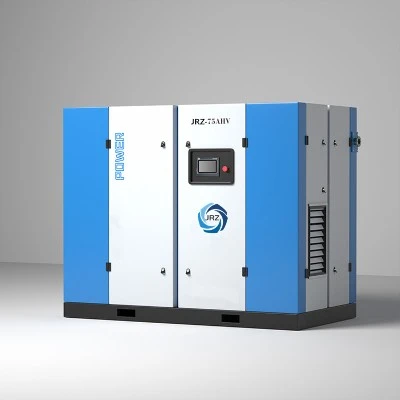
3. Rotary Screw Air Compressors: A Common Choice for Industrial Applications
Rotary screw air compressors are among the most widely used compressors in modern industry.
They use two intermeshing screw rotors to compress air through continuous rotary movement.
Unlike piston compressors, which rely on reciprocating motion, screw compressors use rotating elements to perform the air intake, compression, and discharge processes.
3.1 Main Features of Screw Compressors
Suitable for extended operating periods
Relatively stable compressed air supply
Compact design
Generally lower vibration than reciprocating compressors
Maintenance intervals depend on the manufacturer's requirements
Suitable for a wide range of industrial applications
3.2 Fixed-Speed vs. Variable-Speed Screw Compressors
Rotary screw compressors commonly use two types of motor control: fixed-speed and variable-speed.
Fixed-Speed Air Compressors
A fixed-speed compressor normally operates at a constant motor speed.
When air demand falls below the compressor's supply capacity, the machine may use load/unload control to regulate its output.
It is important to understand that unloading does not mean zero power consumption. The motor and related systems continue to consume electricity even when the compressor is not delivering air at full capacity.
Fixed-speed compressors may be suitable for applications where:
Air demand is relatively stable
The compressor operates close to its rated load for extended periods
Initial equipment cost is an important consideration
Frequent output adjustment is not required
Variable-Speed Drive (VSD) Air Compressors
A variable-speed compressor uses a variable frequency drive (VFD) to adjust motor speed according to actual air demand.
For example, a factory may have high air consumption during daytime production but significantly lower demand at night.
A VSD compressor can reduce its operating speed when demand decreases, helping to avoid unnecessary air production.
Variable-speed compressors may be suitable for applications where:
Air consumption fluctuates frequently
Different production shifts have significantly different air requirements
The compressor spends considerable time operating at partial load
The factory wants to improve energy efficiency
3.3 Is a Variable-Speed Compressor Always More Energy-Efficient?
Not necessarily.
The energy-saving potential of a VSD compressor depends largely on the actual air demand profile.
If a compressor operates continuously at a stable, high load, a variable-speed model may not provide significant energy savings compared with a properly selected fixed-speed unit.
The energy consumption of the variable frequency drive itself, the compressor's operating range, and the control system design should also be considered.
Purchasing Tip:
Do not choose a VSD compressor simply because it is marketed as more energy-efficient.
Ask the supplier to provide performance data under the expected operating conditions, including input power, air delivery, and specific power.
3.4 What Is Specific Power?
Specific power is an important indicator of compressor energy efficiency.
It describes how much input power is required to deliver a certain volume of compressed air.
A commonly used unit is:
kW/(m³/min)
Under the same working pressure and measurement conditions, a lower specific power generally indicates better energy efficiency.
For example, two compressors with the same 75 kW motor rating may have different air delivery capacities and energy performance.
Therefore, buyers should compare motor power, actual air delivery, and specific power rather than looking at motor power alone.
4. Mobile Air Compressors: Diesel or Electric?
Mobile air compressors are designed for applications where compressed air equipment needs to be moved between work locations.
They are commonly available in diesel-powered and electric-powered versions.
4.1 Diesel Mobile Air Compressors
Diesel mobile compressors are commonly used in remote construction and outdoor operations.
Main features:
Do not normally require an external electrical power supply
Suitable for remote job sites
Good mobility
Can supply compressed air to drilling equipment and pneumatic tools
Require diesel fuel
Require engine maintenance and attention to exhaust emissions and noise
Typical applications include mining, tunneling, road construction, bridge projects, and other outdoor engineering operations.
4.2 Electric Mobile Air Compressors
Electric mobile compressors are suitable for applications where electrical power is available but equipment needs to be relocated.
Main features:
Require an external electrical power supply
Operating costs depend largely on local electricity prices
No on-site diesel engine exhaust emissions
Suitable for temporary construction work and equipment maintenance
Require confirmation of site voltage, frequency, and power capacity
Typical applications include factory maintenance, urban construction, and temporary operations near a suitable power supply.
4.3 How to Choose Between Diesel and Electric Mobile Compressors
|
Comparison |
Diesel Mobile Compressor |
Electric Mobile Compressor |
|
Power source |
Diesel engine |
Electric motor |
|
External power required |
Normally no |
Yes |
|
Remote sites without electricity |
Suitable |
Not suitable without a power source |
|
Operating cost |
Depends on diesel prices |
Depends on electricity prices |
|
Emissions |
Produces engine exhaust |
No on-site engine exhaust |
|
Maintenance focus |
Engine and compressor system |
Motor and compressor system |
Purchasing Tip:
Before purchasing a mobile compressor, confirm:
Rated discharge pressure
Rated air delivery
Engine or motor power
Equipment weight and dimensions
Whether a trailer-mounted design is required
Applicable local emissions regulations
5. Oil-Injected vs. Oil-Free Air Compressors: How Clean Must the Compressed Air Be?
This is an important consideration when selecting an air compressor.
Different industries have different requirements for oil, moisture, and particle contamination in compressed air.
Choosing the wrong compressor or air treatment system may affect production quality and equipment performance.
5.1 Oil-Injected Screw Air Compressors
In an oil-injected screw compressor, lubricating oil is injected into the compression chamber during operation.
The oil serves several important functions:
Lubricating the screw rotors
Removing heat generated during compression
Improving sealing between the rotors
Reducing friction during operation
Most of the oil is separated from the compressed air by the oil separator before the air leaves the compressor.
Oil-injected compressors are widely used in general manufacturing, machining, construction, and pneumatic tool applications.
However, an oil separator alone cannot guarantee completely oil-free compressed air. Additional air treatment equipment may be required depending on the final air quality requirements.
5.2 Oil-Free Air Compressors
Oil-free compressors are designed so that lubricating oil is not used in the compression chamber.
They are commonly used in industries where oil contamination in compressed air must be strictly controlled.
Typical applications include:
Food processing
Pharmaceutical manufacturing
Medical-related applications
Precision electronics manufacturing
Specialized chemical production
The main advantage of an oil-free compressor is that it reduces the risk of oil contamination during the compression process.
However, oil-free does not automatically mean that the compressed air contains no other contaminants.
Moisture, dust, microorganisms, and contamination from downstream piping may still need to be removed through appropriate filtration and drying systems.
5.3 How to Determine Whether an Oil-Injected or Oil-Free Compressor Is Required
The decision should not be based only on the industry name.
For example, different processes within a food manufacturing facility may have different compressed air quality requirements.
ISO 8573-1 is a commonly referenced international standard for classifying compressed air quality based on particles, water, and total oil content.
Purchasing Tip:
If a customer requires oil-free compressed air, clarify the following:
Is an oil-free compressor specifically required?
Is a particular compressed air oil-content class required?
Are inspection reports or certifications needed?
Is an adsorption dryer or additional filtration required?
Do not promise that the final compressed air will be completely free of contaminants simply because the compressor is described as oil-free.
6. Compressed Air Treatment: More Than Just the Compressor
Many buyers focus only on the compressor itself and overlook the importance of downstream air treatment equipment.
During compression and distribution, compressed air may contain moisture, oil aerosols, and solid particles.
Without appropriate treatment, these contaminants may affect production quality and equipment service life.
Common compressed air treatment equipment includes air receiver tanks, air dryers, and filters.
6.1 Air Receiver Tanks
An air receiver tank is used to store compressed air within the system.
Its main functions include:
Storing a certain volume of compressed air
Supporting short periods of peak air demand
Helping stabilize system pressure
Allowing some liquid moisture to settle out
The required tank capacity depends on compressor output, air demand fluctuations, system pressure, and control strategy.
An air receiver tank cannot replace an air dryer or precision filtration system.
6.2 Air Dryers
Air dryers reduce the moisture content of compressed air.
The two common types are refrigerated air dryers and desiccant air dryers.
Refrigerated Air Dryers
These dryers cool compressed air so that water vapor condenses into liquid water, which is then removed through a drainage system.
Typical applications include general manufacturing, pneumatic tools, and standard machining operations.
A typical pressure dew point is around +3°C, although actual performance depends on equipment design and operating conditions.
Desiccant Air Dryers
These dryers use desiccant materials to absorb moisture from compressed air.
They can achieve much lower pressure dew points than refrigerated dryers.
Typical applications include precision electronics, pharmaceutical manufacturing, and other processes requiring very dry compressed air.
Depending on the application, required pressure dew points may be -20°C, -40°C, or even lower.
6.3 Compressed Air Filters
Compressed air filters remove contaminants such as solid particles, liquid water, and oil aerosols.
Common filter types include:
General-purpose line filters
Water separators
Oil removal filters
Activated carbon filters
High-efficiency particulate filters
Different filters provide different levels of filtration and serve different purposes.
Purchasing Tip:
More filters do not automatically mean better air quality.
Filter selection should be based on the required air quality, compressed air flow rate, and system pressure.
Filter pressure drop should also be considered because it can increase the energy consumption of the compressed air system.
7. Five Important Technical Parameters to Understand Before Buying an Air Compressor
These are among the most important specifications in air compressor selection.
7.1 Motor Power
Unit: kW
Motor power indicates the rated power of the motor driving the compressor.
Common ratings include:
7.5 kW, 11 kW, 15 kW, 22 kW, 37 kW, 55 kW, 75 kW, 90 kW, and 110 kW.
In simple terms, motor power indicates the size of the motor, but it cannot independently determine the actual air delivery capacity.
Two compressors with the same motor power may provide different air delivery rates and energy efficiency.
7.2 Working Pressure
Units: bar or MPa
Working pressure indicates the pressure level required by the compressed air system.
Common industrial pressure ratings include:
7 bar, 8 bar, 10 bar, and 13 bar.
Different production machines require different working pressures.
For example, some pneumatic tools operate at approximately 7 bar, while specialized industrial equipment may require higher pressure.
Remember that the pressure required at the point of use is not necessarily the same as the compressor outlet pressure.
Piping, filters, and air dryers all contribute to pressure losses.
7.3 Air Delivery / Free Air Delivery (FAD)
Units: m³/min or L/min
Air delivery is one of the most important parameters in compressor selection.
It indicates how much compressed air a compressor can supply per minute under specified measurement conditions.
In simple terms:
Pressure indicates how strongly the air is supplied, while air delivery indicates how much air is available.
The number of air-consuming machines and their individual air requirements determine the total air demand.
When comparing air delivery figures from different manufacturers, always check whether they are measured under the same standards and operating conditions.
7.4 Power Supply Requirements
Important specifications include:
Voltage
Frequency
Phase
For example:
380 V / 50 Hz / 3 Phase
This indicates a three-phase electrical supply with a voltage of 380 V and a frequency of 50 Hz.
Electrical standards vary between countries and regions. Export buyers must confirm the electrical requirements at the installation site before ordering.
7.5 Noise Level
Unit: dB(A)
Noise level indicates the sound produced by the equipment during operation.
It is particularly important when the compressor is installed inside a factory, near operators, or in an area with specific noise restrictions.
When comparing noise levels, check the measurement distance, testing environment, and measurement method.
8. Other Important Factors in Air Compressor Selection
In addition to the main technical specifications, several other factors can directly affect compressor performance.
8.1 Ambient Temperature and Altitude
The operating environment can influence compressor cooling capacity and actual performance.
For example:
High ambient temperatures may affect cooling performance.
High altitude may affect air density and equipment performance.
Poor ventilation may cause excessive operating temperatures.
Dusty environments may increase the load on intake air filters.
For customers operating in mines, high-temperature factories, or high-altitude areas, confirm the permitted operating conditions and any required performance corrections with the manufacturer.
8.2 Installation Space and Ventilation
An air compressor cannot simply be placed anywhere there is available floor space.
Buyers should consider:
Equipment dimensions
Maintenance and service clearance
Air intake and exhaust ventilation
Cooling requirements
Pipe connections
Floor loading and installation requirements
Installation space and ventilation are particularly important for large industrial screw compressors.
8.3 Standby Compressor Requirements
Factories that cannot afford production interruptions may need standby compressor capacity.
For example, one compressor may operate while another remains on standby, or multiple compressors may operate together.
This arrangement can reduce the risk of production interruptions during maintenance or unexpected equipment failure.
The actual configuration should be determined according to production continuity requirements, air demand, and redundancy plans.
8.4 Maintenance and After-Sales Support
Purchasing an air compressor is not just a one-time investment. It also involves long-term operation and maintenance.
Before purchasing, buyers should understand:
Whether local after-sales service is available
Whether commonly used spare parts are easy to obtain
Whether filters and lubricants are readily available
What maintenance intervals are recommended
Whether technical support is provided
How long critical spare parts take to supply
For international buyers, after-sales service and spare parts availability are especially important.
9. Common Mistakes to Avoid When Buying an Air Compressor
Mistake 1: Comparing Motor Power Without Checking Air Delivery
The same motor power does not necessarily mean the same air delivery.
Better approach:
Compare motor power, working pressure, air delivery, and specific power together.
Mistake 2: Focusing Only on the Purchase Price
Air compressors consume energy throughout their operating life.
For equipment that runs for extended periods, electricity costs can become a major part of the total cost of ownership and may exceed the initial purchase price.
Better approach:
Consider equipment cost, energy consumption, maintenance expenses, spare parts costs, and expected service life.
Mistake 3: Assuming Variable-Speed Compressors Are Always Better
The energy-saving benefits of a VSD compressor depend on actual air demand fluctuations.
Better approach:
Understand the customer's air demand profile before choosing between fixed-speed and variable-speed control.
Mistake 4: Assuming Oil-Free Compressors Do Not Need Air Treatment
Oil-free compressors reduce the risk of oil contamination during compression, but they do not automatically remove moisture, particles, or other contaminants.
Better approach:
Select air dryers and filters according to the required compressed air quality.
Mistake 5: Buying Only the Compressor Without Considering Air Treatment Equipment
A complete compressed air system may require an air receiver tank, air dryer, filters, and condensate drainage equipment.
Better approach:
Confirm whether the quotation covers the compressor alone or a complete compressed air system.
Mistake 6: Ignoring Local Power Supply Requirements
If the customer's local voltage, frequency, or phase does not match the compressor configuration, the equipment may not operate correctly.
Better approach:
Confirm the electrical specifications before placing an order and request written confirmation from the supplier.
Mistake 7: Ignoring Maintenance and Spare Parts Costs
Some compressors may have a relatively low initial purchase price but higher maintenance or spare parts costs over time.
Better approach:
Check the availability and prices of common consumables such as air filters, oil filters, oil separators, lubricants, and maintenance kits.
10. Air Compressor Selection Checklist
Use the following table as a starting point when evaluating different applications.
|
Customer Requirements |
Equipment or Configuration to Consider |
Main Reason |
|
Small repair shop with intermittent air demand |
Piston air compressor |
Relatively simple design and lower initial investment |
|
Factory requiring long operating hours |
Industrial screw air compressor |
Suitable for extended operation |
|
Frequently fluctuating air demand |
VSD screw compressor or multiple-compressor control system |
Can adjust air supply according to demand |
|
Stable air demand |
Fixed-speed screw compressor may be suitable |
Relatively straightforward control system |
|
Outdoor construction without electricity |
Diesel mobile air compressor |
Does not depend on an external power grid |
|
Mobile operation with electrical power available |
Electric mobile air compressor |
Suitable for powered mobile applications |
|
Strict oil contamination requirements |
Oil-free compressor with suitable air treatment |
Helps meet specific compressed air quality requirements |
|
Very dry compressed air required |
Desiccant air dryer |
Can achieve low pressure dew points |
|
Fluctuating peak air demand |
Properly sized air receiver tank |
Helps buffer demand fluctuations |
|
Strict particle and oil aerosol requirements |
Appropriate compressed air filters |
Improves compressed air quality |
11. Questions Industrial Buyers Should Answer Before Purchasing an Air Compressor
When a customer requests a quotation for a complete air compressor, do not start by asking only about the brand or budget.
First, understand the actual application and technical requirements.
The following questions are useful for sales teams and equipment suppliers.
|
Question |
English Expression |
|
What type of air compressor do you need? |
What type of air compressor do you need? |
|
What motor power do you require? |
What motor power do you require? |
|
What working pressure do you need? |
What working pressure do you need? |
|
What air delivery capacity do you require? |
What air delivery capacity do you require? |
|
How many hours does the compressor operate per day? |
How many hours does the compressor operate per day? |
|
Is your air consumption stable or does it fluctuate? |
Is your air consumption relatively stable or does it fluctuate? |
|
Do you use an oil-injected or oil-free compressor? |
Do you use an oil-injected or oil-free compressor? |
|
What are the voltage and frequency requirements at your location? |
What are the voltage and frequency requirements at your location? |
|
What is the main application of the compressor? |
What is the compressor mainly used for? |
|
Do you also need an air dryer and filters? |
Do you also need an air dryer and filters? |
If the customer does not know the exact compressor model, you can start by understanding the actual air requirements and then ask a technical specialist to assist with equipment selection.
Air compressor selection involves technical calculations and should not be finalized based on a few basic questions alone. The final configuration should be confirmed by the manufacturer or a qualified technical team.
12. Conclusion: Choose the Right Compressor for the Actual Application
There is no single air compressor that is best for every application. The right choice depends on the customer's actual operating requirements.
Piston compressors are suitable for certain small-scale and intermittent applications. Rotary screw compressors are widely used in industrial production. Mobile compressors are designed for construction and other applications requiring mobility. Oil-free compressors are used where compressed air oil contamination must be strictly controlled.
A professional purchasing decision should consider more than the initial equipment price.
Before placing an order, make sure to evaluate:
Does the air delivery capacity meet production requirements?
Is the working pressure appropriate?
Is the compressor suitable for the required operating hours?
Is the energy consumption economical?
Does the compressed air quality meet production requirements?
Is the air treatment system properly configured?
Are the local power supply and installation conditions suitable?
Are maintenance and spare parts readily available?
Remember: Understand the air demand first, select the appropriate compressor type, confirm the technical specifications, and then compare brands and prices.
That is the foundation of making the right air compressor purchasing decision.


