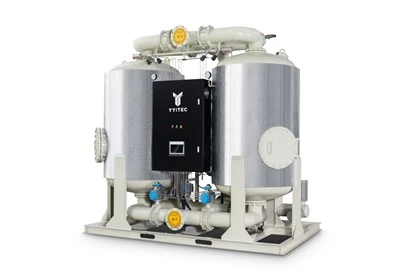
100 m³/min blower‑purge heated regeneration compressed air dryer, water‑cooled, PLC control, near‑zero compressed‑air consumption. Ideal for petrochemical, electronics & food‑beverage. Request quotation today.
Product Overview
Our Model JRZ‑YDXGL‑100 blower‑purge heated regenerated desiccant air dryer delivers stable deep drying for large‑flow compressed‑air systems with a rated capacity of 100 m³/min, working pressure of 7 bar and water‑cooled configuration. Different from heatless or minimal‑heat desiccant dryers that waste valuable process compressed‑air for regeneration, this PSA‑based unit adopts independent ambient‑air blower for heating regeneration, achieving nearly zero consumption of finished dry compressed air, which greatly cuts long‑term energy cost for continuous‑running heavy‑duty industrial air‑compressor stations.
This large‑capacity twin‑tower dryer is purpose‑built for sites requiring consistent low‑dew‑point compressed air under 24‑hour continuous duty cycle. It is fully assembled with PLC automatic control system, multi‑stage inlet protection filtration, heavy‑duty pneumatic switching valves and water‑cooling module. Factory pre‑wiring and pre‑assembly shorten your on‑site installation workload. Custom modification on working pressure, voltage, desiccant filling and connection flange standards is supported for project‑specific requirements.
Full Technical Specifications (Model JRZ‑YDXGL‑100)
| Parameter | Unit | Value / Description |
|---|---|---|
| Model No. | - | JRZ‑YDXGL‑100 |
| Rated handling capacity | m³/min | 100 |
| Working pressure | bar | 7 (working range: 6‑10 bar customizable) |
| Total motor power | kW | 50 |
| Voltage / Frequency | V/Hz | 380V 50Hz (415V/60Hz available for customization) |
| Cooling method | - | Water Cooled |
| Overall dimension(L×W×H) | mm | 2830 × 1680 × 3140 |
| Control mode | - | PLC automatic cycle control |
| Desiccant option | - | Activated alumina / silica gel |
| MOQ | Pcs | 1 |
| Payment terms | - | Paypal, T/T, Western Union, Visa |
| Shipping option | - | Sea freight / Air freight |
How This 100m³/min Blower‑Purge Dryer Works (PSA + External‑Heated Regeneration)
Working on pressure‑swing‑adsorption (PSA) principle combined with blower‑assisted external heated regeneration, two adsorption towers run alternately to guarantee uninterrupted dry‑air supply, no production downtime during regeneration cycle.
Adsorption Phase
Wet compressed‑air flows upward through the desiccant bed inside the on‑line adsorption tower. High‑performance activated‑alumina or silica‑gel adsorbent traps moisture vapour, oil aerosol and fine contaminants from incoming compressed‑air. Treated dry compressed‑air flows out toward downstream production equipment.
Blower‑Heated Regeneration Phase
While one tower keeps drying compressed‑air, the offline saturated tower goes through regeneration. A dedicated blower draws ambient atmospheric air and sends it through electric stainless‑steel heater. Hot ambient air flows **top‑down reversely** through saturated desiccant bed, raising bed temperature to strip adsorbed moisture out from desiccant pores. Moist hot exhaust is vented directly to atmosphere, **without tapping your valuable production compressed‑air**.
Bed Cooling & Thermal‑Shock Prevention
After high‑temperature heating regeneration is finished, hot desiccant bed cannot switch into adsorption work immediately. The system runs cooling procedure: ambient unheated air passes through tower bed to bring down desiccant temperature gradually. This step avoids thermal‑shock damage to adsorbent material and prevents unstable dew‑point output caused by over‑hot bed.
Automatic Tower Cycle Switching
PLC programmable controller manages all valves, heater, blower and timing logic. Towers swap adsorption / regeneration roles automatically according to pre‑set cycle (4‑8 hours adjustable based on actual load fluctuation). Operators do not need manual intervention under normal running condition.
Core Product Advantages - Real‑World Operational Benefits
Note: Below content differentiates from generic vendor descriptions; each point links hardware feature to your actual plant‑side return.
•Near‑Zero Compressed‑Air Consumption (Blower Purge Design)
Traditional heatless desiccant dryers consume 12‑15% of finished compressed‑air as purge gas for regeneration. Our blower‑purge structure uses independent blower‑supplied ambient air instead. Compressed‑air loss is minimized, greatly reducing your compressor power load and monthly electricity expenditure for large‑flow air‑station. This advantage becomes more obvious for 24/7 continuous‑operation factories.
•Long‑Life Desiccant Bed with Anti‑Channeling Structure
The 100 m³/min large‑flow model is equipped with over‑sized desiccant chamber, built‑in airflow distribution plates and anti‑impact baffles. These internal components eliminate airflow channeling (local shortcut air flow inside tower). Uniform air distribution across full bed avoids partial over‑saturation of desiccant, extending desiccant service life and stabilizing dew‑point performance under variable load.
•Corrosion‑Resistant High‑Efficient Heating Assembly
High‑grade stainless‑steel heating elements are adopted instead of ordinary carbon‑steel heaters. Anti‑corrosion capability adapts to humid workshop environment, reducing heater burnout risk. Optimized heat‑exchange structure improves thermal utilization rate and cuts redundant power waste.
•Reliable Switching Valves for Non‑Stop Large‑Flow Operation
Double‑eccentric butterfly valves with pneumatic actuators serve as core switching components for twin‑tower conversion. These heavy‑duty valves are selected specially for 100 m³/min huge flow condition, resisting frequent cyclic switching wear, minimizing internal leakage risk. Stable valve performance avoids dew‑point drift caused by cross‑tower air leakage.
•Multi‑Stage Pre‑Filtration Protect Desiccant From Oil & Liquid Water
Integrated multi‑stage inlet filter package (cyclone separation + coalescing filter + mesh filter) removes liquid water, oil aerosol and solid particles before wet compressed‑air enters adsorption tower. Oil contamination is the top killer for desiccant failure. Built‑in filtration system greatly lowers desiccant poisoning risk and preserves stable adsorption capacity long‑term.
Typical Industrial Application Scenarios
This large‑flow blower‑purge heated air dryer is engineered for processes where moisture‑free compressed‑air directly impacts product quality, equipment stability and production yield.
1. Food & Beverage Industry
Supply clean dry compressed‑air for packaging line, material mixing and conveying. Prevent moisture‑induced mold risk, satisfy hygiene requirements for indirect‑contact food‑grade air system. Oil‑free upstream compressor matching is strongly recommended.
2. Electronics & Semiconductor Manufacturing
Eliminate condensed‑water risk on PCB assembly, precision component production. Even tiny moisture can trigger circuit defect, corrosion or short‑circuit failure for sensitive electronic workshops. Stable low‑dew‑point air reduces production reject rate.
3. Chemical & Petrochemical Plants
Provide reliable instrument air for pneumatic control valves, transmitters and plant control system. Dry compressed‑air avoids internal corrosion of instrument pipelines, also fits catalyst regeneration and other chemical‑process where moisture will trigger unwanted chemical reaction.
4. Telecommunication Infrastructure
Dry pressurizing air for cable and waveguide system, prevent internal metal corrosion and signal attenuation of long‑distance communication cable network.
Critical Operation & Maintenance Guidance for Large‑Flow Dryer
Large‑capacity 100 m³/min dryer requires standardized operation to avoid unexpected breakdown and maintain long‑term stable dew‑point performance.
1. Inlet compressed‑air temperature must keep below 45 ℃, inlet pressure stay within 0.6‑1.0 MPa. Over‑high inlet air temperature will overload heater and accelerate desiccant aging.
2. After power‑on, PLC will run automatic drying‑regeneration cycle. Tower switching cycle can be adjusted between 4‑8 hours based on real‑site humidity and load condition.
3. Monitor dew‑point reading via controller display routinely. If dew‑point deviates far from target value, inspect two points first: desiccant saturation status and heater normal working condition.
4. Maintenance schedule: Replace desiccant every 3‑5 years according to operating hours and inlet air oil‑pollution level. Inspect blower running condition annually, check valve sealing performance periodically. All on‑site work shall follow local industrial safety regulations.
Selection Notes - When You Should Choose This Dryer
✅ Suitable conditions:
•Continuous‑running large‑flow compressed‑air station ≥ 80 m³/min;
•You want to cut compressed‑air purge loss and reduce long‑term plant energy‑cost;
•Demanding low dew‑point requirement for production / instrument air;
•Site has cooling‑water supply for water‑cooled configuration.
⚠️ Not ideal for:
•Intermittent short‑time discontinuous operation;
•No cooling‑water resource on‑site (we can discuss air‑cooled customized version).
Real Customer Reviews


Frequently Asked Questions
Q1: What pressure dew‑point can this 100m³/min blower‑purge dryer deliver?
A: Under nominal working condition, stable pressure dew‑point ‑40℃ can be achieved; deeper dew‑point can be realized via customized desiccant formula.
Q2: Can I change voltage for overseas project such as 415V‑60Hz?
A: Yes, we support non‑standard voltage & frequency customization to match local power grid.
Q3: How long is delivery lead‑time for Model JRZ‑YDXGL‑100?
A: Standard unit lead‑time around 4‑6 weeks; customized configuration will add extra production cycle. Contact our sales team for exact schedule.
Customization & Delivery Information
We support multi‑dimension customization for this heated compressed‑air dryer: working‑pressure adjustment, voltage‑frequency adaptation, desiccant type swap, air‑cooled alternative, special‑flange connection, local‑standard certification matching. You can send your detailed working‑condition parameters (actual airflow, working pressure, inlet temperature, target dew‑point, power supply, cooling condition) via email or inquiry form, our engineering team will evaluate and provide targeted proposal for your project.
📧 infor@aircompressorglobal.com
Hot Tags: Blower‑Purge Heated Regenerated Air Dryer 100m³/min | Water‑Cooled PSA Desiccant Dryer, China Blower‑Purge Heated Regenerated Air Dryer 100m³/min | Water‑Cooled PSA Desiccant Dryer manufacturers, suppliers